 Mason scientists employ a rapid-result, saliva-based test that significantly expands testing capacity, and an antibody test that can track vaccine response.
- In the first national study to assess use of e-cigarettes among adults with disabilities, George Mason University’s College of Health and Human Services researchers found that e-cigarette use was more than twice as likely among adults with a cognitive disability (12.0%), an independent living disability (11.0%), or two or more disabilities (9.2%), compared to adults without disabilities (4.8%)
-
George Mason University is collaborating with Amazon and the Maryland Chamber Foundation to provide local teachers with computer science externships and education in a pilot program to begin this summer.
- George Mason University has two online graduate programs ranked first in Virginia by U.S. News & World Report, leading the state in curriculum and instruction and accounting.
- Saskia Popescu has been a go-to consultant for hospitals and the World Health Organization, helping to control infections and prepare for new outbreaks.
- On Wednesday, Mason alumna Ariana Freeman spent the day inside the U.S. Capitol Rotunda covering her first presidential inauguration as a broadcast associate for CBS Evening News.
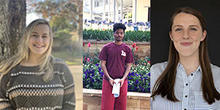 Four seniors majoring in statistics––Emily Litzenberg, Kate Lang, Nate Mulugeta, and Shannon Connor––received an honorable mention for the best use of external data at the American Statistical Association’s (ASA) Fall Data Challenge 2020.
- George Mason University is welcoming students back to campus on January 25 for the start of the Spring semester.
- President Biden is expected to immediately return the U.S. to the Paris Agreement.
- Mason's School of Business is co-hosting an online conference on preserving and rebuilding a viable retail industry in the Washington, D.C., area.
-
George Mason University’s Institute for a Sustainable Earth (ISE) has named its first cohort of ISE Faculty Fellows.
- New George Mason University Study finds that health care professionals with a greater personal ability to respond to change experienced lower rates of burnout when their work environments offered strong communication, teamwork, and leadership support. This is one of the first studies to explore the effect of individual and organizational capacity for change on burnout among health care professionals.