
In This Story
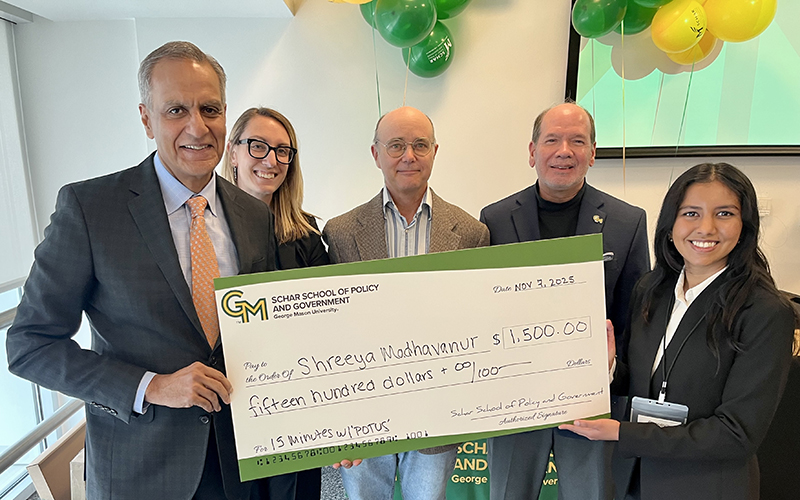
Imagine you have just 15 minutes to brief the President of the United States on a complex global security issue. That is the test at the heart of the “15 Minutes with POTUS” competition, an annual policy challenge hosted by the Schar School of Policy and Government at George Mason University. This year’s event drew 50 of the nation’s top undergraduates from 22 universities, each tasked with presenting a multilateral strategic solution to a modern national security threat.
Rising above the intense competition was Rice University junior Shreeya Madhavanur, who claimed the title of 2025 Policy Briefing Champion for her compelling proposal to establish a Biosecurity Civil Communications Initiative within NATO. Judges commended her precision and poise under questioning, qualities that earned her the top prize and highlighted the competition’s growing reputation as a training ground for the nation’s future policy leaders.
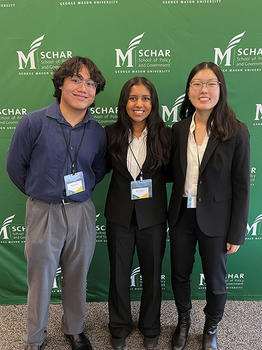
This year’s competition ended Friday, November 7, with the finalists’ presentations in front of a panel of distinguished judges. Finalists were chosen after first-round written brief submissions, judged by Schar School PhD students.
Madhavanur, a business management major with minors in politics, law and social thought, and medical humanities, took home the $1,500 first-place prize. University of Richmond’s Nicholas Ramon Javier, a junior studying history with a Chinese minor, placed second, winning $750, and William and Mary senior Kara (last name withheld by request), a public policy and global studies double major, came in third, winning $500.
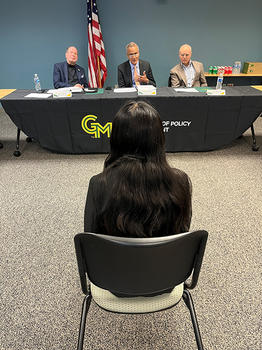
The three-member judging panel included Ambassador Rich Verma, former U.S. ambassador to India andformer deputy secretary of state for management and resources, who currently serves as chief administrative officer at Mastercard; Schar School Adjunct James P. Danoy, former national security briefer to President Obama; and Schar School Associate Professor Jeremy Mayer, director of the Master of Political Science program and a noted scholar of American politics who has trained rising diplomats at the State Department. Verma served as “President,” with Danoy and Mayer serving as “Cabinet members” giving contestants a realistic high-pressure briefing environment.
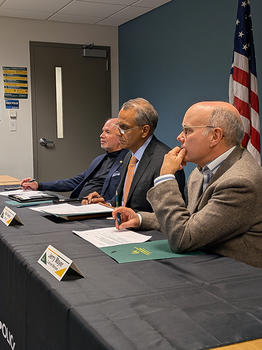
“The briefers gave us excellent insight into the most pressing issues of the day that we need to act on, and act on decisively,” said Verma following the briefings. “I’m so inspired and impressed by how well they did, not only with the subject matter, but on how well they presented.”
The presentations, despite the 15-minute time limit, were dense with data and delivered with passion.
Madhavanur said the idea for her briefing, which called for POTUS to champion a multinational effort to combat misinformation in the world’s health infrastructure, rose from classroom discussions in a course on responsible AI and public health.
“It had so many policy ramifications; it got me thinking about this,” she said.
Javier said his brief, which asked for support in the Philippines and addressed Chinese “below warfare” efforts to disrupt the island nation, said, “as a Filipino American, I’ve spent time thinking about this part of the world on a personal level. I have friends who are interested in cybersecurity, so I began to explore how those two worlds connect.”
And as for Kara, her brief on strengthening alliances to safeguard the development and distribution of the world’s precious minerals, which saw a national security issue, stemmed from a recent paper she wrote about microchips.
“I feel like there’s a secret story going on in U.S. policy,” she said after her brief. “The [actual president] has expressed a lot of interest in rare earth minerals; it’s a critical part of our military and our economy.”
The judges brought their real-world experience into the judging room at George Mason’s Van Metre Hall at Mason Square in Arlington, Virginia—just across the Potomac River from the White House—underscoring the contest’s commitment to realism and proximity to the nation’s policymaking centers.
The momentum was high, but so was the pressure. “POTUS” and the two cabinet members frequently cut in with sharp, unexpected questions that pushed contestants to adjust their arguments in real time. They met the challenge head-on, staying composed and focused as they navigated each curveball with confidence.
“Does that answer your question, Mr. President?” Madhavanur asked POTUS after a reply. “It does? Perfect.”
The students making their debut briefings had already accomplished one of the main skills of briefing, Danoy said.
“It's all about preparation, preparation, preparation, and knowing your subject matter extremely well,” he said, recalling his own briefing sessions with Obama. “You have to know your subject so well that you’re prepared to answer any of the tough questions that might come up during the presentation.”
To that end, Mayer said he was “impressed with the presentation, but I was more impressed with their ability to think on their feet and answer questions that they couldn't have prepared for.They were sharp and bode well for the future of the country.”
Beyond the formal competition, students also benefited from extensive professional development opportunities woven throughout the event. Finalists received one-on-one time with the judging panel and received constructive feedback on both their policy proposals and presentation styles. Participants also had the chance to meet individually with Schar School Career Services for tailored résumé reviews and career guidance. These individualized sessions ensured that every student left the competition not only with a deeper understanding of national security policymaking, but with strengthened professional skills they can carry into internships, graduate programs, and future public service careers.
“Fifteen Minutes with POTUS” offers students a rare, hands-on introduction to the realities of policymaking under pressure. The competition sharpens analytical and communication skills while building the confidence needed for future roles in diplomacy, intelligence, and national security. As the event continues to grow in prominence, it is fast becoming a benchmark experience for students aspiring to careers in public service and global leadership. Stay tuned for the launch of next year’s contest.
Additional reporting by Jessica Bates.