

Driving Responsible Digital Innovation and Sustainable Infrastructure
From artificial intelligence and robotics to digital twins and quantum computing, new technologies are reshaping every aspect of life and culture at a rate faster than most of our institutions can keep up with. AI models are growing exponentially in power and complexity, and some physical infrastructures are aging, while others, like data centers, are pushing against environmental constraints to keep up with demand. George Mason is researching and applying technologies that improve human life and a peaceful coexistence in increasingly digital societies by enhancing democratic connectivity, economic opportunity, and reducing disparities through public services while also protecting the planet. Through cross-disciplinary collaboration, workforce education, and public–private partnerships, George Mason is helping shape a digital future that is as ethical as it is advanced.
Grand Challenge Initiative
George Mason’s Grand Challenge Initiative is a university-wide collaboration addressing humanity’s most pressing challenges through six interlocking strategies, supported by a $15 million investment over five years.
On this page
THE GEORGE MASON ADVANTAGE
As Virginia’s most innovative university, George Mason is a national leader in responsible digital innovation—combining technical excellence, societal commitment, and unmatched regional partnerships.
George Mason is home to Virginia’s first master’s in artificial intelligence and PhD in robotics, the nation's first Responsible AI Graduate Certificate, and the only Virginia university in the NIST AI Safety Consortium. Our researchers lead in areas like cybersecurity, digital ethics, neuromorphic computing, and AI for climate resilience.
We serve as the Northern Virginia Node of the statewide Commonwealth Cyber Initiative and collaborate with industry leaders like Google, AWS, and Dominion Energy to build sustainable, secure, and inclusive technologies for the public good.
Bold AI Strategy: George Mason is the first public university in the nation with a comprehensive AI vision. Its four strategic pillars—Integrate, Inspire, Innovate, and Impact—span education transformation, workforce preparation, research leadership, and societal adoption.
Digital Innovation in Action
RESEARCH IN ACTION
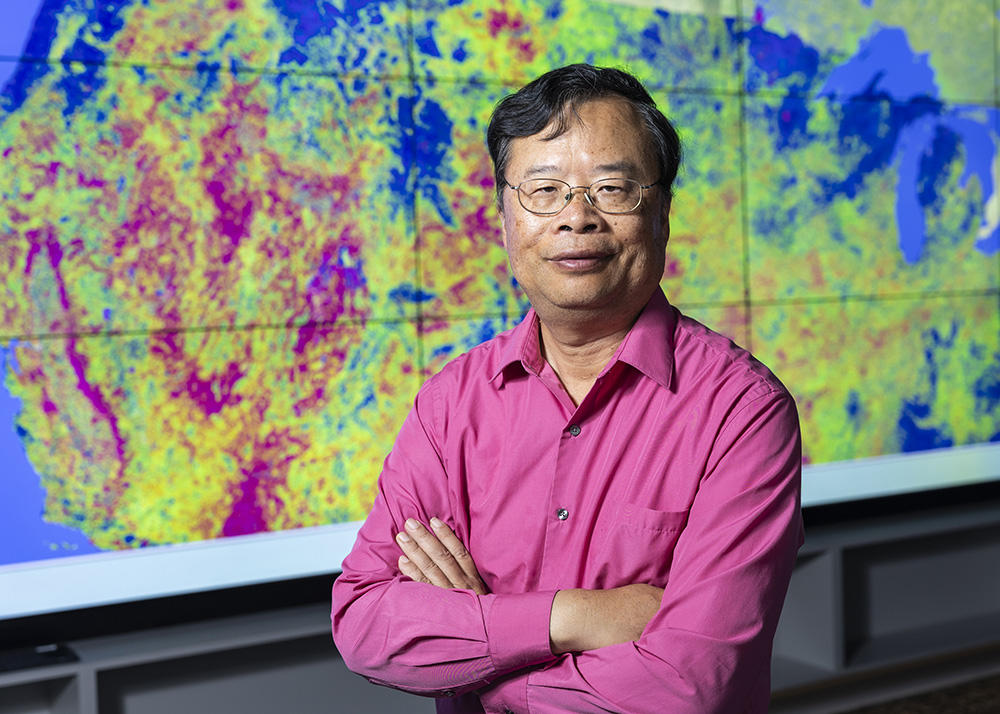
Liping Di, Director and Professor, Spatial Information Science and Systems Center. Photo by Ron Aira.
User-inspired digital twin helps with crop management decisions
The user-inspired CropSmart Digital Twin decision tool will help take the guesswork out of crop management decisions with services that are easily accessible via web portals and smartphone apps.
Led by George Mason researcher Liping Di, CropSmart is one of seven projects selected to advance in the National Science Foundation’s Convergence Accelerator program, which supports solutions to challenges in food and nutrition security and successful crop production.

George Mason PhD candidate Andres Rosero, pictured here with "Pepper," is exploring deception and human-robot interactions. Photo by Ron Aira/Office of University Branding
Looking at deception and human-robot interactions
How likely are humans to trust a robot, especially if that robot has the capacity to lie? This is the question George Mason University psychology doctoral candidate Andres Rosero is exploring in his research on human-robot interaction.
“As robots become more integrated in human society, their roles will transition into those of a collaborative nature rather than as tools used by people,” said Rosero, who works in Applied Psychology and Autonomous Systems (ALPHAS) Lab in the Human Factors and Applied Cognition Program. “In response, these robots must be programmed with enough social awareness to navigate complex interpersonal interactions to build relationships and maintain a positive interaction with the humans they share their environment with.”
STUDENT RESOURCES
Competitive Edge
From on-campus hackathons and pitch competitions to national competitions, George Mason undergraduates and graduate students have many opportunities to share their ideas and inventions and compete at the national level.
Mason Autonomy and Robotics Center
The Mason Autonomy and Robotics Center (MARC) provides students with research and educational opportunities that cross disciplines to address global needs in autonomy, embedded AI, and robotics.
PatriotAI
Co-developed with community members and Mason’s AI Visioning Task Force, PatriotAI is a suite of six specialized AI tools offering secure, university-managed access to large language models for learning, instruction, research, and administration.
NuScale Energy Exploration (E2) Center
With the opening of the NuScale Energy Exploration (E2) Center at Fuse at Mason Square, students gain access to a state-of-the-art simulator replicating a NuScale modular nuclear reactor control room, bridging theory with hands-on practice.
Lab for Immersive Technologies & Simulation
A national leader in harnessing virtual reality and simulation to advance public health and improve lives, Mason’s College of Public Health is home to the nation’s first SSH-accredited Lab for Immersive Technologies and Simulation at a public health college.
Stanley and Rosemary Hayes Jones Networking Testbed Lab
The Networking Testbed Lab supports faculty and student research in secure communications, antenna systems, next-G and O-RAN innovations, autonomous vehicles, smart grids, and national defense applications.
FACULTY SPOTLIGHTS

Jesse Kirkpatrick, codirector of the Mason Autonomy and Robotics Center, is an International Security Fellow at New America and serves as a consultant for numerous organizations. His research focuses on the ethics of peace and security, emphasizing the ethical, social, and policy implications of emerging technologies.

Amarda Shehu, the university’s inaugural vice president and chief artificial intelligence officer (CAIO), leads the strategy and implementation of AI across research, academics, and partnerships for the university.

Elizabeth Phillips, director of the Applied Psychology and Autonomous Systems (ALPHAS) Lab and codirector of the Human-Robot Interaction Lab, studies how robots and other technologies are changing the way humans interact with the world and one another.

Massimiliano Albanese, executive director of the Institute for Digital Innovation, is a recognized expert in cyberattack modeling and detection, optimal defense strategies, and adaptive security technologies.
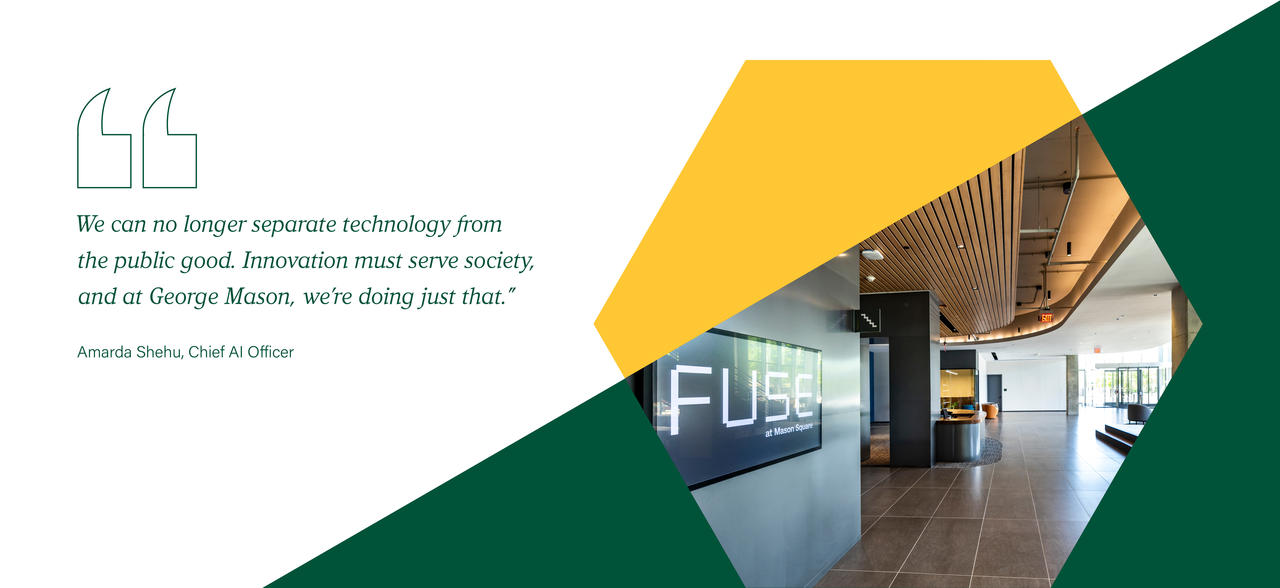
"We can no longer separate technology from the public good. Innovation must serve society, and at George Mason, we're doing just that."
PARTNERSHIPS AND COMMUNITY ENGAGEMENT
In addition to leading CCI’s Northern Virginia Node, George Mason collaborates with federal and state agencies and hosts the nation’s first Center for Small Business AI Innovation.
CCI Northern Virginia Node
CCI encompasses 10 Virginia universities, colleges, and community colleges. Its Northern Virginia Node, headquartered at George Mason, also engages with regional industry and local government.
NSI–Howard Cybersecurity Clinic
The National Security Institute’s Cyber and Tech Center (CTC) at the Antonin Scalia Law School and Howard University School of Business (HUSB) have receive $1 million from Google’s Cybersecurity Clinics Fund to establish the NSI CTC – HUSB Cybersecurity Clinic.
Tech Talent Investment Program
Virginia's Tech Talent Investment Program (TTIP) is a state-wide program to invest in expanding state computer science, computer engineering, and software engineering degrees over a 20-year period. This program, started in 2019 and running until 2039, will see roughly 380 additional degree recipients each year.
Virginia Alliance for Semiconductor Technology
The Virginia Alliance for Semiconductor Technology is a collaborative network of semiconductor, microelectronics, nanotechnology industries, and Virginia colleges and universities providing access to state-of-the-art research facilities and training programs to bolster workforce access in addition to advocating the growth of semiconductors.
Learn more about Virginia Alliance for Semiconductor Technology
MITRE Immersive Simulation Partnership
George Mason partners with MITRE on research using immersive virtual reality. MITRE’s SIMEX simulation labs, located McLean, Virginia, offer a special mix of technical and operational capabilities for government agencies that want to try out new ideas by using state-of-the-art laboratories.
PODCASTS
Cybersecurity and the global threats of tomorrow
In this fast-paced episode of Access to Excellence, Jaffer and George Mason President Gregory Washington discuss the U.S.'s position on the global stage, the power of the American Dream, and what we as citizens can do to start solving some of the country's stickiest problems.
Podcast: Navigating AI’s risks and rewards
On this episode of Access to Excellence, President Gregory Washington and George Mason’s inaugural vice president and chief AI officer, Amarda Shehu, discuss the research possibilities of AI and the role of higher education in AI training and development.
AI-in-Gov: Inside the Black Box explores how artificial intelligence is transforming government—from innovation to impact.
Listen to AI-in-Gov
NEWS
- January 15, 2026
- November 4, 2025
- October 27, 2025
- October 14, 2025
- June 4, 2025
EVENTS
Connect with Mason faculty, students, and partners at lectures, hackathons, and community events focused on AI, cybersecurity, and digital innovation.
Browse upcoming events to see where you can join the conversation, on campus and across the region.