
Building a Climate-Resilient Society
George Mason University is applying science, policy, and innovation to safeguard communities and ecosystems through sustainable practices and infrastructure, real-time weather-related information, and community planning and preparedness training. From a solar-powered greenhouse that explores resilient food production and sustainable systems that allows for food security to advanced predictive modeling and engineering nature-based infrastructures that identify or advanced predictive modeling that identifies weather-related or other natural disasters, the university is developing the leadership and talent to produce solutions alongside partners on a global scale.
Grand Challenge Initiative
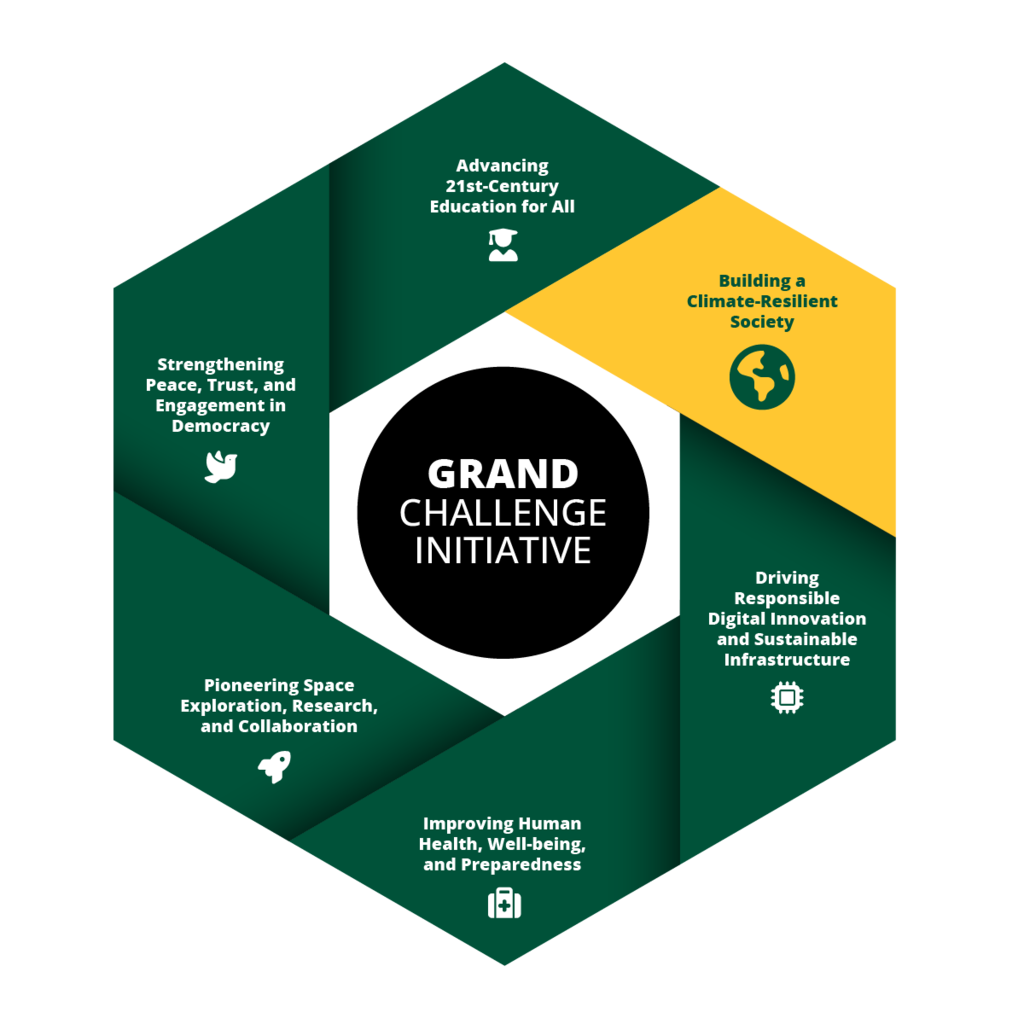
George Mason’s Grand Challenge Initiative is a university-wide collaboration addressing humanity’s most pressing challenges through six interlocking strategies, supported by a $15 million investment over five years.
THE GEORGE MASON ADVANTAGE
In 2023, George Mason was selected to host the Virginia Climate Center and lead research on tackling climate-related challenges, such as energy, vector-borne illnesses, and extreme weather and flooding in Northern Virginia and throughout the commonwealth. Funded through the National Oceanic and Atmospheric Administration (NOAA) and sponsored by the late U.S. Representative Gerry Connolly, this congressionally directed community project seeks to increase Virginia’s resiliency to the impacts of climate changes.
Watch Hyperlocal | Momentum in Research
On this page
RESEARCH IN ACTION

Flood Hazard Engineering and Adaptation course. Photo provided.
Civil engineering students are helping local communities improve their flood resilience
“Flooding is a growing issue across local communities,” said Celso Ferreira, who leads George Mason’s Flood Hazards Research Lab. “It is one part of engineering that’s not well-solved. Communities want to understand and adapt to flood risk, but it’s expensive. That’s where this idea came in—we thought, why not involve students? Not just teach them engineering but help them create useful products for these communities.”
Ferreira recently redesigned the CEIE 445/645 Flood Hazard Engineering and Adaptation course to work with community partners to deliver real projects as part of the Institute for a Sustainable Earth’s NSF Accelerating Research Translation Seed Translational Research Project Program.
In the course, undergraduate and graduate civil engineering students work together on teams to develop flood risk maps and conduct analyses to help real clients in local communities improve their flood resilience. For some communities, especially smaller counties or tribes with fewer resources or no engineers on staff, this can provide critical data to help them address areas at higher risk of flooding.
The student teams used the recently developed Virginia Department of Conservation and Recreation (DCR) models, which provided ground elevation surface (topography), hydraulic friction values, and surface water infiltration values. This served as a common framework each project could be built upon.

Photo by Shutterstock.
VCC releases first statewide climate assessment
George Mason’s Virginia Climate Center (VCC) has unveiled the commonwealth’s first comprehensive, peer-reviewed climate assessment—a landmark report that provides science-based insights into Virginia’s changing climate and its impacts on communities, infrastructure, and the economy.
The first Virginia State Climate Assessment synthesizes decades of research into a single, accessible resource for policymakers, businesses, educators, and the public. Developed by a multidisciplinary team across the commonwealth and the region, this report establishes a critical baseline for understanding how past, present, and future climate conditions will shape life in Virginia.
“This groundbreaking statewide assessment gives us what we've never had before: comprehensive, science-based evidence of the risks we face and the information we need to protect our communities, economy, and natural heritage for generations to come,” says Jim Kinter, VCC director and coordinating author of the assessment.
While national and global climate reports provide broad trends, they cannot capture Virginia’s specific vulnerabilities. The commonwealth’s geographic diversity—from coastal plains to mountainous terrain—combined with rapid population growth and economic expansion—create region-specific risks that require localized solutions.
STUDENT RESOURCES
Patriot Green Fund
George Mason’s Mason Facilities sets aside $100,000 a year for the Patriot Green Fund, which supports infrastructure improvements and student research projects to make George Mason’s campuses more sustainable. Projects have included smart hives, rain gardens, and the Foragers Forest on the Fairfax Campus.
Green Leaf Programs and Courses
George Mason has more than 125 Green Leaf courses across 25 academic programs, covering topics from EcoArt to sustainable tourism, all designed to help raise environmental awareness while providing students with a comprehensive knowledge of their local and global environment.
Climate Resilience and Adaptation Minor
The Climate Resilience and Adaptation (CRA) minor is designed to complement students' primary areas of study with specialized knowledge in climate science and policy, local and regional climate adaptation strategies and solutions, and how to translate research into practice and action.
FACULTY SPOTLIGHTS

Jennifer Salerno, a professor in the Department of Environmental Science and Policy, is helping redefine how we monitor and protect coral reef ecosystems. In collaboration with Woods Hole Oceanographic Institution, Salerno is working on a technique to assess coral reef health by analyzing microorganisms in reef water.

College of Science researcher Alireza Ermagun is working in collaboration with Villanova University and the University of South Carolina on a $1.8 million NSF grant studying how frequent, low-level flooding disrupts daily transportation systems and finding solutions.

Jenna R. Krall of the College of Public Health is a biostatistician with research interests in air pollution and environmental epidemiology. Her work has been focused on developing methods for estimating sources of air pollution and their associations with health.

Daniel Tong of George Mason’s Center for Spatial Science and Systems is part of the NASA Health and Air Quality Applied Sciences Team working on improvements to the National Air Quality Forecast Capability.

PARTNERSHIPS AND COMMUNITY ENGAGEMENT
Smithsonian-Mason School of Conservation (SMSC)
In a unique partnership, George Mason and the Smithsonian Conservation Biology Institute established the Smithsonian-Mason School of Conservation (SMSC), offering hands-on, interdisciplinary programs in conservation where students can work alongside Smithsonian scientists and conservation experts from around the world.
Centro de Apoyo Familiar and the Lamb Center
George Mason researchers are partnering with two nonprofit organizations, Centro de Apoyo Familiar and the Lamb Center, to understand how environmental hazards affect those experiencing housing insecurity and homelessness. The multidisciplinary project will utilize national-level housing, air quality, heat, demographic, and vulnerability data to identify U.S. counties that are at the greatest risk of impacts to housing insecure and unhoused populations.
FUTURE-READY INFRASTRUCTURE
Living Lab
From the canopies of the trees in the accredited Level II Arboretum to the stormwater running into Mason Pond, George Mason’s nearly 1,000 acres of land, waterways, forests, and buildings is being used as a dynamic Living Lab for hands-on environmental research that may one day have an impact globally.

The Institute for a Sustainable Earth (ISE)
The Institute for a Sustainable Earth (ISE) faculty, staff, and students engage with communities of practice on George Mason’s campuses, in the region, nationally and globally, to ensure a deep understanding of the challenges that enable or constrain the development and adoption of sustainable solutions. ISE focuses not only on natural and engineered systems but also the socio-economic-legal systems that impact community sustainability and resilience and enable the development of holistic solutions.
Potomac Environmental Research and Education Center (PEREC)
The Potomac Environmental Research and Education Center (PEREC) is a key component of George Mason’s Potomac Science Center in Belmont Bay, focusing on Potomac River restoration and local sustainability practices, so that the local ecosystem will be healthy for years to come. Research is translated into award-winning field programs for K-12 students and the larger community.
Center for Ocean-Land-Atmosphere Studies
The Center for Ocean-Land-Atmosphere Studies is a research center dedicated to understanding climate fluctuations on seasonal, interannual, and decadal scales, with special emphasis on the interactions between Earth’s atmosphere, oceans, and land surfaces.
The Center for Climate Change Communication
Since 2007, the Center for Climate Change Communications in the College of Humanities and Social Sciences has helped change the way local media, communities, and organizations talk about climate change. They study audiences and conduct original research on climate communication.
NEWS
- February 19, 2026
- January 26, 2026
- January 15, 2026
- November 19, 2025
- June 25, 2025